


.svg)
Why Your TransUnion and Equifax Scores Differ- and What Credit Report Errors Have to Do with It
.png)
Why Your TransUnion, Experian, and Equifax Scores Are Different & How Credit Report Errors May Be Involved
One of the most confusing things about credit scores is how exactly they are calculated. The three major credit bureaus, Experian, TransUnion, and Equifax, each maintain their own credit report using different data sources. Because the information in those reports can vary, and different scoring models may be used, the credit scores you see may not be the same. Many consumers are especially curious about why their TransUnion and Equifax scores are so different from each other.
In the TransUnion vs Equifax match up, sometimes these differences are due to proprietary variance in the way the credit bureaus process and weigh data. In other words, they have different secret formulas they use.
Other times, these differences are due to credit report errors in one or both reports. Credit scores can affect many aspects of a person’s life, so it’s worth understanding how these mistakes happen, and what you can do if you find an error.
QUICK ANSWER
Your credit score is different on different websites because each site may show a different scoring model (like VantageScore 3.0 or a FICO Score), use data from a different credit bureau, or update on a different day. A small gap is normal. A gap between your TransUnion, Equifax and/or Experian scores that doesn’t shrink over time can be a sign that one of your credit reports contains an error.
Credit and consumer reporting drew roughly 5.8 million complaints to the Consumer Financial Protection Bureau (CFPB) in 2025, about 88% of everything the agency received, according to its 2025 annual report.
Top Reasons Your Credit Scores Are Different (And When It’s a Problem)
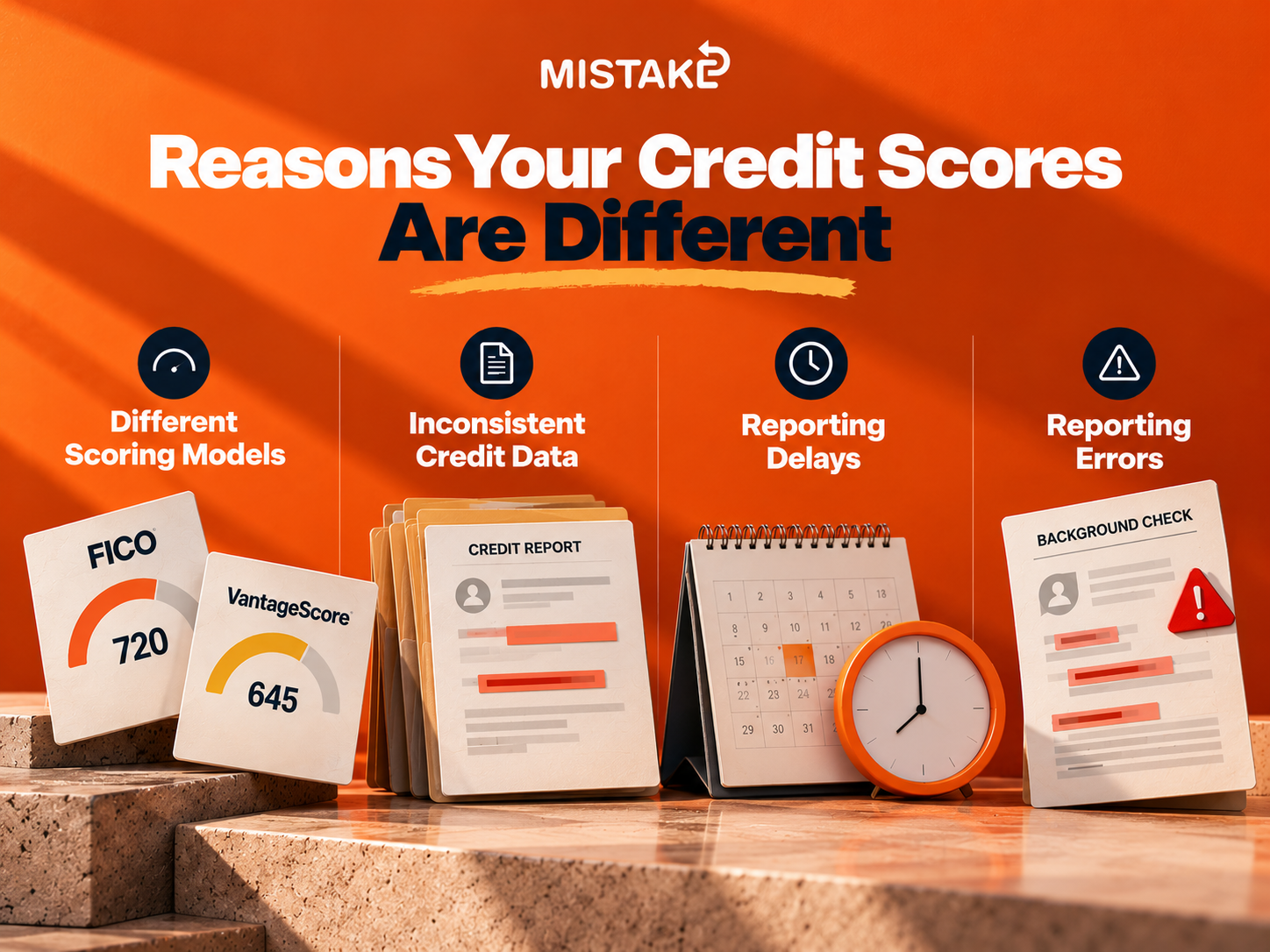
There are three main reasons for credit score differences from each of the credit bureaus: different scoring models, inconsistent credit data, and reporting delays.
Different Scoring Models
Not only does each credit bureau have its own way of calculating credit scores, but there are also two different primary scoring models: FICO and VantageScore.
FICO (Fair Isaac Corporation) scores are widely used by lenders for major lending decisions, including mortgages, auto loans, and credit cards. There are also multiple versions of FICO. That means the FICO score you see in your banking app may not be the same version a mortgage lender or auto lender uses when reviewing your application.
VantageScore was developed by the three major credit bureaus and was designed in part to score a broader range of consumers, including people with limited credit histories. Many lenders and credit card issuers use VantageScore, although FICO has historically been more widely used in lending decisions. In 2026, the agency that oversees Fannie Mae and Freddie Mac began allowing mortgage lenders to use VantageScore 4.0 in place of Classic FICO scores and expanded that option to all approved lenders in September 2026.
FICO and VantageScore also weigh credit information differently. Both consider factors such as your payment history, credit utilization, or how much of your available credit you use, and the age of your accounts. However, each model may give those factors different levels of importance. As a result, the same underlying credit information can produce different scores depending on the model and version being used.
Inconsistent Credit Data Between Bureaus
Different scoring models can produce different scores even when the underlying data is identical. But sometimes the data itself is different from one credit bureau to another.
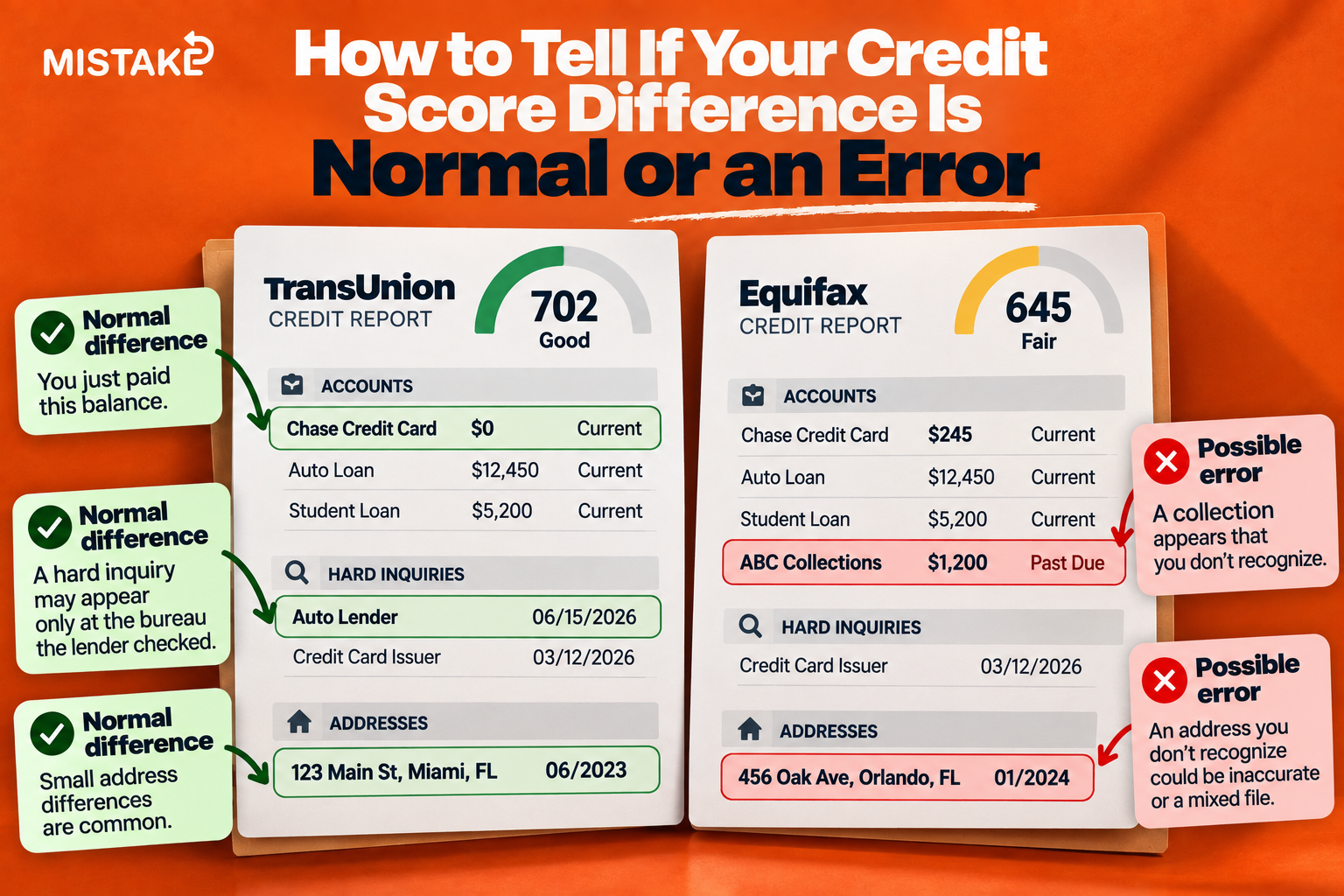
For example, one credit report may contain a missing or duplicate account, an incorrect balance, inaccurate payment history, a debt collection that does not belong to you, incorrect personal information, or another reporting error. An account may also appear on one bureau's report but not the others.
This is where a difference between your scores can become more concerning. If your Equifax score is significantly lower than your TransUnion or Experian score, for example, compare the actual credit reports rather than focusing only on the numbers. An inaccurate or incomplete item on one report could be contributing to the difference.
Credit bureaus reporting errors is a major red flag area and is often actionable under the Fair Credit Reporting Act (FCRA), which means that you may have grounds to file a lawsuit under certain circumstances.
Reporting Delays and Timing Issues
Sometimes a difference between your credit reports is temporary and does not mean anything is wrong.
Lenders and other companies that furnish information to the credit bureaus may report updates at different times. The bureaus can also process those updates on different schedules. As a result, one credit report might already reflect a recently paid credit card balance, new account, payment, or other change while another report has not yet been updated.
These timing differences can temporarily affect your credit scores. However, if a discrepancy persists or one bureau continues reporting information that you know is outdated or incorrect, it is worth reviewing the underlying reports more closely.
Why Is My Credit Score Different on Different Websites?
Your credit score is different on different websites because each website shows a specific score: one scoring model, one version of that model, calculated on a certain date. Change any one of those things and the number can change. Here’s what most consumers look at:

The Hidden Danger: Credit Report Errors That Lower Your Score
When looking at the three main drivers of differences between TransUnion and Equifax scores (scoring models, inconsistent data, and reporting delays), this type of data handling (or mishandling) adds up to the potential for a lot of credit report errors.
The most common errors on credit reports are:
- Wrong Payment History: payments showing as unpaid or late
- Wrong Accounts: whether caused by an identity theft credit report showing false accounts in your name due to fraud, a mixed credit report showing false accounts that belong to someone else, or something else, these errors are a big problem.
- Incorrect Balances and Credit Utilization: failing to indicate that a balance has been paid down or paid off, or that a line of credit has been closed in good standing, can make it look like your available credit is maxed out when, in reality, you use it wisely.
- Duplicate Entries: listing the same account, debt, line of credit, mortgage, auto loan, collection account, or anything else more than once can make your credit look twice as crazy as it probably already feels. Yes, decision makers can pick through the entries and try to figure it all out, but they shouldn’t have to and may not even realize they need to.
- Inaccurate Personal Data: wrong birthdates, addresses, spellings of your name, etc., can seem minor but still stir up big trouble.
What Lenders See and Why Errors Matter More Than You Think
Whenever a lender credit check is run, there’s a chance of being denied due to a credit report error. Here’s what happens:
- Lenders may pull your credit report from one or multiple credit bureaus. After reading this article, you understand why they may use more than one (credit data can be all over the map). Looking at Equifax and TransUnion, for instance, may show different things.
- You can’t control which report they look at, unfortunately. So even if you know that your TransUnion credit report consistently looks better than your Equifax credit report, it’s not up to you.
- A single inaccurate report can cost you an approval. Even if you’ve spent 30 years amassing the most amazing credit history imaginable and priding yourself on your outstanding credit score, one inaccurate report can bring your plans down faster than a house of cards in a windstorm.
This matters most for a mortgage. Mortgage lenders generally pull all three credit reports and use your average score. Say your scores are 740 at TransUnion, 735 at Experian, and only 680 at Equifax because of an error on your Equifax report. Your average score would be 735. Let’s say another error also drags your Experian score down to 700, your middle score then drops to 700, and that one number can change your rate or your approval. These numbers are hypothetical, but the math is how it works.
How to Dispute Credit Report Errors: Two Approaches
When you need to fix credit report mistakes, there are two possible approaches. First, you can handle everything yourself. Second, you can let Mistake.com handle the dispute for you. The steps are similar for either approach, so let’s take a look at where the credit report dispute process differs depending on which approach you choose:
- When you spot an error on one credit report, get a copy of all three credit reports. You can do this for free at annualcreditreport.com. Equifax, Experian, and TransUnion combined to bring this verified site to life so consumers could have easy access. Free reports are available from all three bureaus every week.
- Carefully review your credit reports and note any inaccuracies, inconsistencies, misleading data, mixed data, false deceased indicators, wrong personal data, etc. Highlight, underline, circle, draw arrows. Let there be no confusion about which data is incorrect.
- Make a copy of this marked up report, along with a well-drafted dispute letter which clearly explains which information is wrong, why it’s wrong, and what documentation you have that proves it. Include copies of your supporting documents as well.
- Submit your dispute package either through the online dispute portal provided for each credit bureau or through certified mail. Be aware that online dispute portals may require you to waive certain legal rights when you agree to the terms of use, and the confirmation and tracking of your dispute is entirely in their hands. If you send it through certified mail (which we recommend), you’re in control of the confirmation, timing, and tracking.
- A separate dispute must be submitted to each credit bureau if errors are found on your report for that credit bureau. Track the dates, retain copies of the dispute and documentation, and keep the receipts for each dispute sent.
- If 30 days comes and goes and your dispute is ignored, nothing is corrected, you’re told that the information was investigated and verified as accurate, the false info was removed only to return again later, or you’ve suffered harm because of the credit report errors, then it’s time to escalate.
- File a lawsuit for FCRA violations. Seek corrections and compensation.
If you approach this process on your own, be careful to document and save everything in case you need it down the road if you choose to file a lawsuit.
If you approach this process using Mistake.com, we handle everything for you. Yep, everything. We take care of the dispute, track the timing, and file the lawsuit, if needed. We seek corrections and compensation on your behalf depending on the circumstances. You don’t pay anything upfront or out-of-pocket to work with our lawyers since the FCRA requires the credit bureau to cover the legal fees.
Other Credit Report Resources

.svg)


