


.svg)
Fix Credit Report Mistakes For Free With Mistake.com
.png)
Dispute Credit Report Errors
Finding an error on your credit report is frustrating, especially when you've worked hard to keep your credit in good shape. A single inaccurate account, incorrect late payment, or debt that doesn’t belong to you can affect your ability to qualify for a mortgage, rent an apartment, get affordable insurance, secure financing, or get the green light for a new job.
Unfortunately, credit reporting mistakes are pretty common. Millions of consumers discover inaccurate information on their credit reports every year, and many spend weeks or even months trying to correct errors through the dispute process.
Here's the good news: federal law is on your side. Under the Fair Credit Reporting Act (FCRA), Equifax, Experian, and TransUnion are legally required to follow reasonable procedures to keep your information as accurate as possible. Companies that furnish information to the credit bureaus such as banks and lenders, also have legal responsibilities when consumers dispute inaccurate information.
This guide explains how the dispute process works, what the law requires, common mistakes consumers make when filing disputes, and when a reporting error may become a legal claim. Whether you are trying to correct your credit report on your own or wondering whether your rights have been violated, this page will help you understand your options.
QUICK ANSWER
To fix a credit report mistake:
- Obtain your free credit reports from Equifax, Experian, and TransUnion.
- Identify every inaccurate account or piece of information.
- Submit a written dispute to both the credit bureau and the company that reported the information.
- Monitor the investigation and review the results carefully.
In most cases, the Fair Credit Reporting Act (FCRA) requires consumer reporting agencies to investigate disputes within 30 days after receiving them. If a credit bureau ignores your evidence, fails to conduct a reasonable investigation, repeatedly reports inaccurate information, or continues reporting errors after they should have been corrected, you may have legal rights.
Depending on the circumstances, consumers may be able to recover compensation for financial losses, emotional distress, statutory damages, attorney's fees, and other remedies available under federal law.
Need Help Fixing a Credit Report Error?
You do not have to figure out whether a credit bureau violated the law on your own. If your dispute was ignored, your credit report still contains inaccurate information, or you have been denied a loan, apartment, insurance policy, or job because of a reporting error, Mistake.com will take a look at your situation for free.
Our credit report error lawyers can help you by:
- Reviewing your credit reports and dispute history.
- Determining whether Equifax, Experian, TransUnion, or a data furnisher violated the FCRA.
- Pursuing correction of inaccurate information.
- Seeking compensation when reporting errors caused financial losses or emotional distress.
- Handling FCRA claims on a contingency fee basis, meaning there are no upfront attorney fees and you pay nothing out-of-pocket.
Many people contact us after spending months trying to fix an error themselves. A free consultation can help you understand whether the problem is simply a dispute that needs more documentation, or whether it has already become a legal claim.
What Actually Counts as a Credit Report Error?
Not every disappointing thing on your credit report is a mistake. A missed payment you actually missed isn't an error, it's just bad news (and it won't stay on your report forever, more on that below). A credit report error is specifically information that is inaccurate, unverifiable, outdated past its legal shelf life, or doesn't belong to you at all.
If any of this sounds familiar, you're not imagining it, and you're far from the only one. These are the exact categories that show up again and again when consumers and their attorneys dig into credit bureau errors.
How Common Are Credit Report Errors?
Credit report errors are not rare. In a congressionally mandated study conducted under Section 319 of the Fair and Accurate Credit Transactions Act, the Federal Trade Commission found that roughly one in five consumers had a confirmed error on at least one of their three credit reports, and approximately one in twenty consumers had an error serious enough to potentially affect the terms of a loan or insurance policy offered to them. Because the three major bureaus maintain files on roughly 200 million Americans, that figure translates into tens of millions of people currently carrying inaccurate data, in many cases without knowing it.
Some consumers discover errors immediately after being denied credit, while others may not realize a mistake exists until they receive an adverse action notice from an employer, landlord, lender, or insurance company.
Why a "Small" Error Can Cause Real Damage
People sometimes brush off credit report errors because the mistake feels small on paper. A late payment that wasn't actually late. A balance that's a little off. But credit scoring doesn't care about intent, it just runs the numbers, and even a single inaccurate entry can be the difference between an approval and a denial.
A credit report error can lead to:
- Loan and credit card denials, even when your real financial history would have qualified you.
- Higher interest rates on the credit you do get approved for, costing you real money over the life of the loan.
- Rental application rejections, especially in competitive housing markets where landlords barely look twice.
- Job offers falling through, for roles that include a credit check as part of the background screening.
- Higher insurance premiums, since some insurers factor credit-based scores into what you pay.
The Fair Credit Reporting Act exists because Congress recognized exactly this: consumer reports carry real financial consequences, so the companies compiling them are legally required to get it right.
Why Credit Report Mistakes Happen
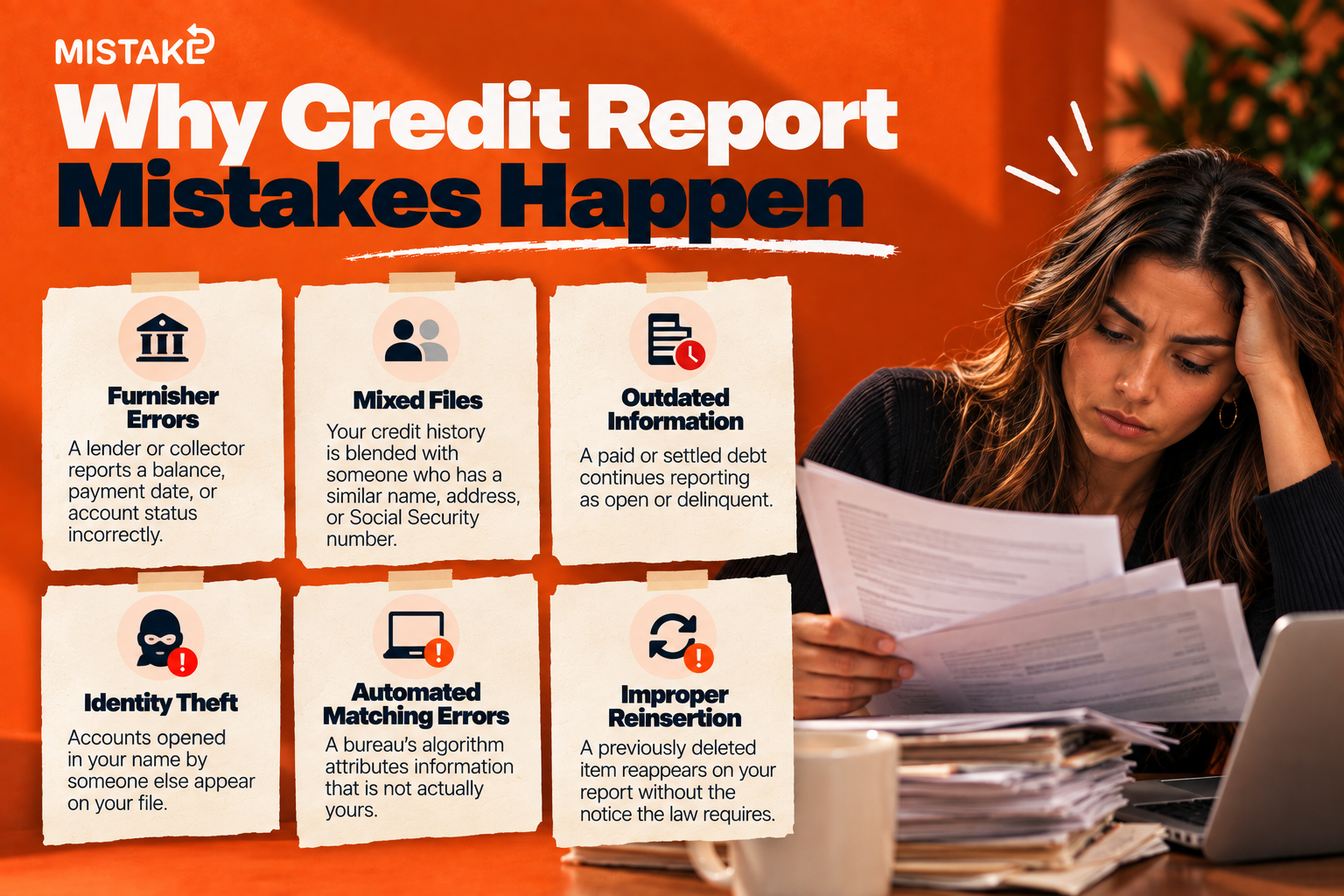
A credit report feels official, so it's easy to assume it must be accurate. In reality, it's built from millions of pieces of information moving between banks, lenders, debt collectors, courts, and automated systems every single day. When something gets entered wrong or matched to the wrong person, the mistake can spread across multiple reports fast.
Credit report errors can appear for a range of reasons:
- Furnisher Errors: A lender or collector reports a balance, payment date, or account status incorrectly.
- Mixed Files: Your credit history is blended with someone who has a similar name, address, or Social Security number.
- Outdated Information: A paid or settled debt continues reporting as open or delinquent.
- Identity Theft: Accounts opened in your name by someone else appear on your file.
- Automated Matching Errors: A bureau's algorithm attributes information that is not actually yours.
- Improper Reinsertion: A previously deleted item reappears on your report without the notice the law requires.
Your Rights Under the Fair Credit Reporting Act (FCRA)
The Fair Credit Reporting Act (FCRA), 15 U.S.C. § 1681 et seq., is the primary federal law that protects consumers from inaccurate, incomplete, or unfair information in their credit reports and other consumer reports. Congress enacted the law to promote fairness, accuracy, and privacy in consumer reporting, recognizing that inaccurate information can have serious financial and personal consequences.
Under the Fair Credit Reporting Act, you have the right to:
- Obtain a free copy of your credit report from each nationwide credit bureau.
- Know what information is contained in your consumer file.
- Dispute information you believe is inaccurate or incomplete at no cost.
- Have the credit bureau conduct a reasonable investigation into your dispute.
- Receive written results after the investigation is completed.
- Have inaccurate or unverifiable information corrected or deleted.
- Receive notice if previously deleted information is reinserted into your report.
- Add a consumer statement if a dispute cannot be resolved.
- Limit access to your credit report to those with a legally permissible purpose.
- Seek damages if your rights under the FCRA are violated.
One of the most important protections in the FCRA is found in 15 U.S.C. § 1681e(b), which requires consumer reporting agencies to maintain reasonable procedures to assure the maximum possible accuracy of the information they report.
This means credit bureaus cannot simply collect information from creditors and publish it without taking reasonable steps to ensure that information is accurate. When mistakes happen, the law provides consumers with a process to have those errors investigated and corrected.
Step-by-Step: How to Dispute a Credit Report Error
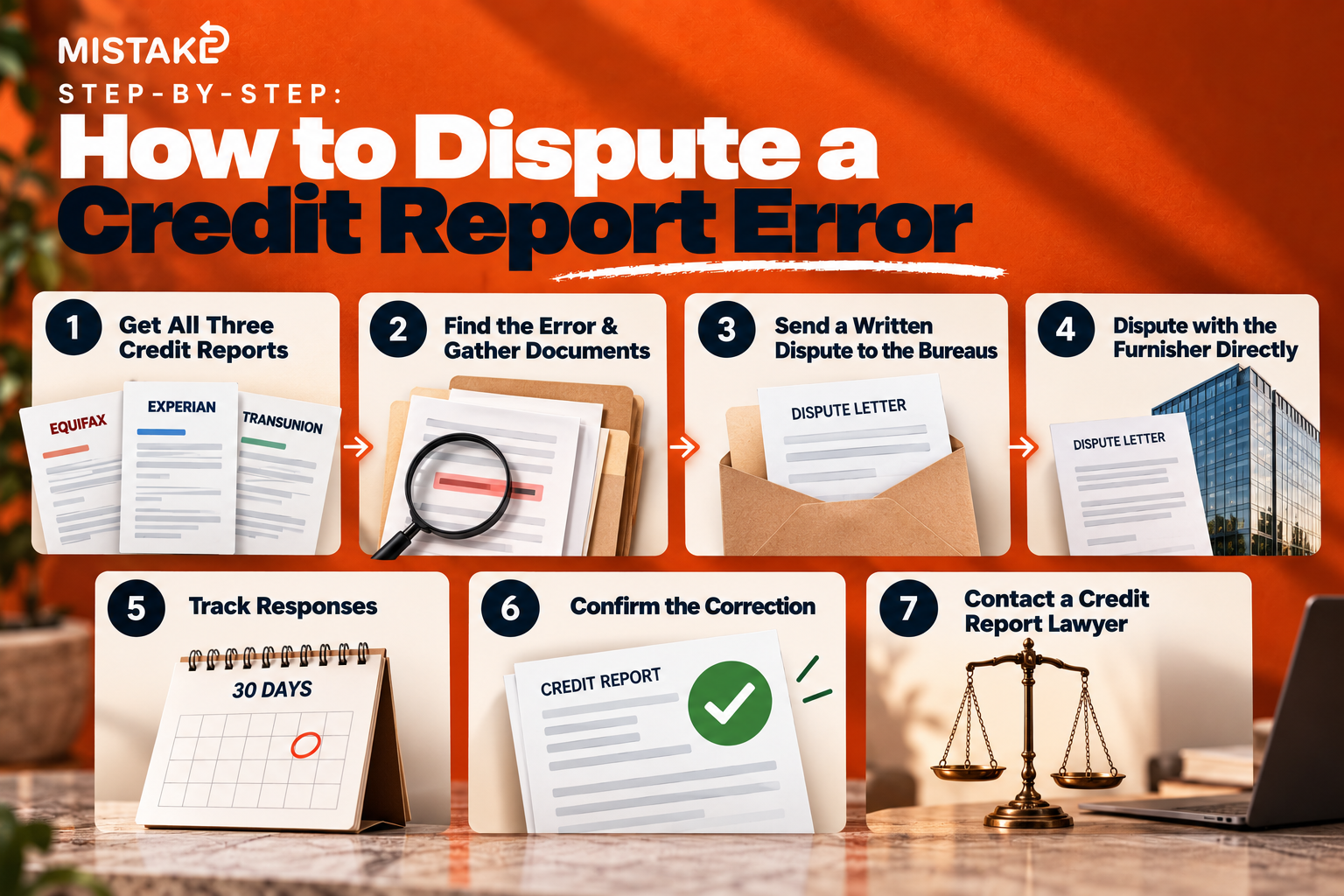
1. OBTAIN ALL THREE OF YOUR CREDIT REPORTS
Errors do not always appear on all three bureaus' files, so review Equifax, Experian, and TransUnion separately. You are entitled to free weekly reports from all three through AnnualCreditReport.com. We recommend obtaining reports directly from AnnualCreditReport.com rather than a consolidated third-party service, since third-party reports can be harder to trace back to the specific source of an error.
2. IDENTIFY THE ERROR AND GATHER DOCUMENTATION
Be specific about which account, which entry, what is wrong, and what it should say instead. Gather supporting evidence such as payment records, court documents, a police report for identity theft, or written confirmation from a creditor that the account is not yours. Keep clean, original copies of every report and any credit denial letters you receive, including the envelopes.
3. SUBMIT A WRITTEN DISPUTE TO THE BUREAUS
Disputes can be filed online, by mail, or by phone, but a written dispute sent by certified mail creates a verifiable record. State clearly what is inaccurate and why, and attach copies (never originals), of your supporting documents.
4. DISPUTE WITH THE FURNISHER DIRECTLY
Send a parallel written dispute to the company that reported the information. Under 15 U.S.C. § 1681s-2(b), a furnisher that receives notice of a dispute has an independent duty to investigate and correct or delete information found to be inaccurate, and to notify all three bureaus of the correction.
5. TRACK RESPONSES
The bureau generally has 30 days from receipt to investigate, or 45 days if you submit additional relevant information during that window. If the bureau determines your dispute is frivolous or irrelevant, typically because it lacks enough details, it may decline to investigate, but it must notify you of that determination, and its reasoning, within five business days.
6. CONFIRM THE CORRECTION
Once the investigation closes, the bureau must provide you with written results and, if a change was made, a free updated copy of your report. Request an updated report to confirm the correction was made and has not silently reverted. After filing a dispute, many consumers assume receiving a "verified" response means the credit bureau thoroughly reviewed their evidence, but that is not always the case.
7. CONTACT A CREDIT REPORT LAWYER
If you've disputed inaccurate information multiple times, the same error keeps returning, or the reporting mistake has already caused financial harm, the credit report lawyers at Mistake.com can help determine whether the issue has become more than a routine dispute. A free consultation can help you understand your rights and whether a legal claim may be appropriate. Contact us today for a free case review.
How Long Can Negative Information Legally Stay on Your Credit Report?
Accurate negative information does not remain on your credit report indefinitely. Under 15 U.S.C. § 1681c, most adverse items, including late payments and collections, must be removed after seven years. Several categories carry different timeframes:
- Bankruptcies may be reported for up to ten years.
- Lawsuits and judgments may be reported for seven years, or until the applicable statute of limitations expires, whichever is longer.
- Information for job applications for more than $75,000 a year isn't subject to the seven-year limit.
- Information for applications for more than $150,000 in credit or life insurance is also not subject to the seven-year limit.
If information remains on your credit report beyond the time permitted by law, you can dispute it. Similarly, if information is inaccurate regardless of its age, you have the right to dispute it. A debt that is legally reportable can still violate the FCRA if it is reported inaccurately.
Mistake.com helps consumers evaluate whether outdated, inaccurate, or improperly reported information may violate federal law. If you are unsure whether the information on your credit report is legally reportable, a free consultation can help you better understand your rights.
Common Mistakes People Make When Filing a Credit Dispute
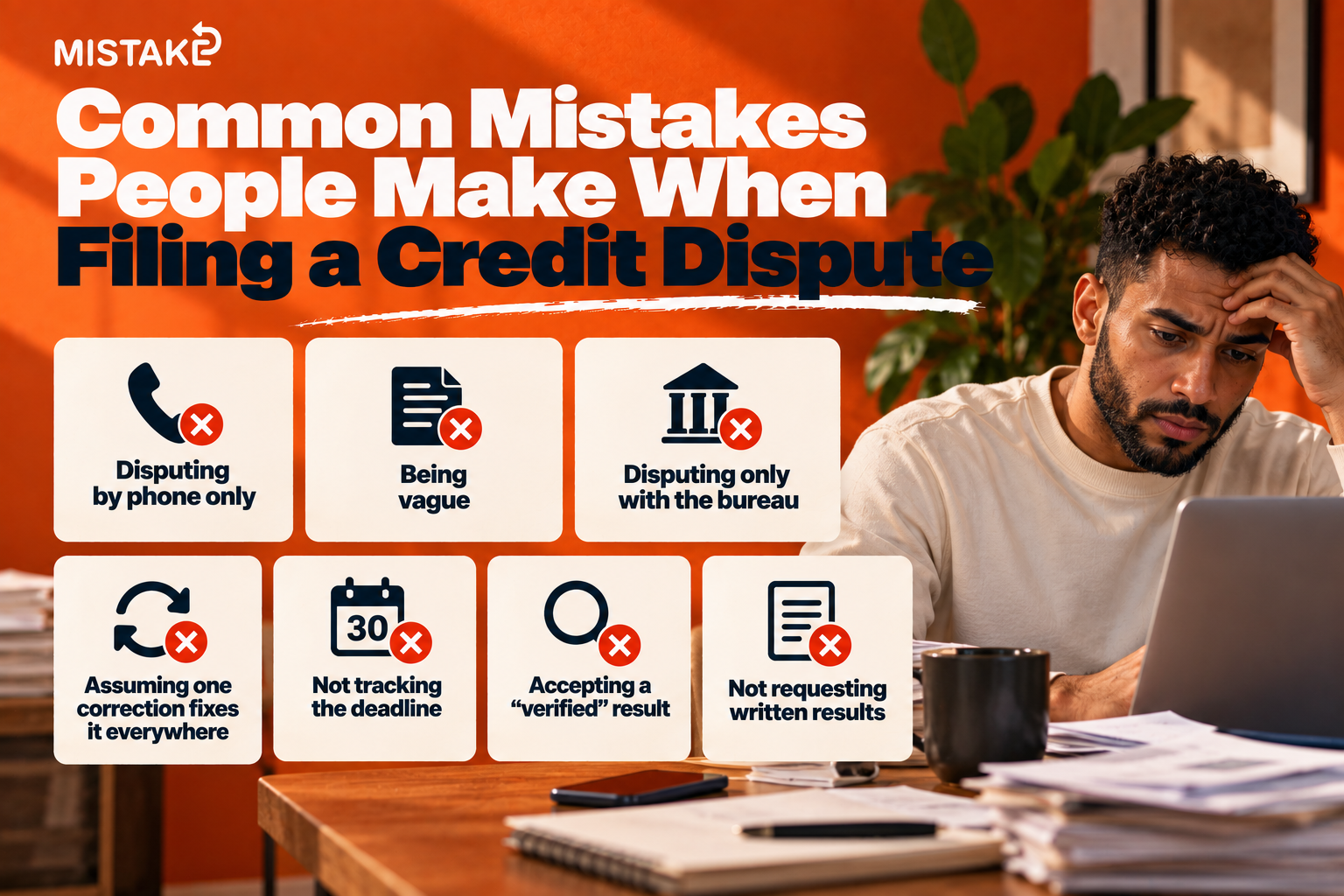
- Disputing by phone only, with no written record of what was said
- Being vague ("this account is wrong") instead of identifying the specific inaccuracy
- Disputing only with the bureau, and not the furnisher
- Assuming one correction fixes it everywhere. An error corrected at one bureau can still appear at the other two.
- Not tracking the 30 or 45 day deadline, or failing to follow up once it passes
- Accepting a "verified" result without confirming the bureau actually reviewed the evidence submitted
- Not requesting written results, which are required by statute and useful if litigation later becomes necessary
Has Your Credit Report Error Become a Legal Issue?
Not every reporting error results in a lawsuit, and many consumers successfully resolve straightforward mistakes through the standard dispute process. However, there comes a point where the issue may no longer be simply correcting inaccurate information. Instead, it may involve determining whether the credit bureau or furnisher complied with its legal obligations under the FCRA.
You may want to speak with a credit report error attorney from Mistake.com if:
- You disputed inaccurate information, but it was never corrected.
- The bureau repeatedly states the information was "verified" despite evidence showing it is inaccurate.
- The same error continues to reappear after being removed.
- Your credit file has been mixed with another person's information.
- Identity theft accounts remain on your report after you reported the fraud.
- You were denied a mortgage, loan, apartment, insurance policy, or employment because of inaccurate information.
- You experienced financial losses, damage to your credit, or significant stress because of reporting errors.
- You believe someone accessed your credit report without a permissible purpose.
Having one or more of these situations does not automatically mean you have a lawsuit. Every case depends on its specific facts, including what information was reported, how the dispute was handled, and whether the companies involved complied with federal law. Our attorneys can evaluate those circumstances and explain whether additional legal remedies may be available.
What Compensation May Be Available in an FCRA Case
Every case is different, and outcomes depend on the specific facts and evidence involved, but the FCRA allows consumers to potentially recover several types of damages when a bureau or furnisher is found to have violated the law, including:
- Actual damages, for financial harm like a denied loan, a lost job offer, or a higher interest rate tied to the error
- Emotional distress damages, for the stress and disruption the error caused
- Statutory damages, which can apply even without proof of financial loss
- Punitive damages, in cases involving willful violations
- Attorney's fees and costs, which the responsible party may be required to pay
There are no guarantees in any legal claim, and not every error rises to the level of a lawsuit. But if a bureau or furnisher failed to do what the law requires, there may be a path to both correcting your report and recovering for the damage it caused.
What Mistake.com Does Differently
We're a law firm, but we don't act like the ones you're picturing. No spam calls, no pressure, no confusing legal-speak. Here's what happens when you bring us a credit report error:
- We review your full credit history and pinpoint every violation, not just the one you noticed.
- We help you gather the documentation that actually strengthens a dispute or a claim.
- We handle the dispute correspondence and track every deadline for you.
- If the bureau or furnisher failed to meet its legal duties, we may file a claim on your behalf.
- We pursue the compensation you may be owed for the harm the error caused, not just a correction.
And because of the FCRA's fee-shifting provision, if we take on your case and the credit bureau or furnisher is found responsible, they're required to cover our legal fees. Not you. There are no out-of-pocket fees or upfront costs when you work with our lawyers.
Other Credit Report Dispute Resources
We believe in giving you more than just our side of the story. Here are some useful resources with more information on disputing credit report errors:
FAQs

Yes. If the bureau failed to conduct a reasonable investigation after you disputed an error, or continued reporting information it knew or should have known was inaccurate, you may be able to sue under federal laws.
The bureau must generally complete its investigation within 30 days of receiving your dispute, or 45 days if you submit additional relevant information during that period, and must report the results to you within five business days after the investigation concludes.
A bureau that fails to investigate, or "verifies" an error without a genuine review, may be violating 15 U.S.C. § 1681i, which can support a legal claim.
Yes, though it often requires more than one round of disputing, since a mixed file can recur across multiple bureaus. Persistent mixed files are among the more common reasons consumers end up needing legal representation.
Yes. Accounts opened fraudulently in your name can be blocked or removed after you file an identity theft report, such as through IdentityTheft.gov, and provide supporting documentation to the bureau.
Not always. Many errors can be resolved through the standard statutory dispute process without an attorney. Legal representation becomes relevant once the bureau fails to correct a verified error, or the error has already caused financial harm.
Any information you believe is inaccurate or incomplete, including account balances, payment history, account ownership, personal identifying information, duplicate listings for the same debt, and public records such as bankruptcies.
No. Filing a dispute, by itself, should not affect your credit score.
Employers running credit-based background checks see the same inaccurate information a lender would, which is one reason uncorrected errors can affect employment decisions as well as credit decisions. Employers generally must obtain your written consent before pulling your credit history.
Most consumer protection attorneys handle FCRA cases on a contingency basis, meaning you pay nothing upfront. If your case succeeds, the statute typically requires the violating party to pay your attorney's fees.
If a reporting error appears on a joint account, both account holders generally have an independent right to dispute inaccurate information affecting a jointly held account.
Generally, claims must be filed within two years of discovering the violation, or five years from when the violation occurred, whichever is earlier, under 15 U.S.C. § 1681p. Because deadlines can vary by circumstance, confirm your specific timeline with an attorney as soon as possible.
Ready to Fix Your Credit Report?
A credit report mistake doesn't have to define your future. If inaccurate information cost you a loan, a home, or a job opportunity, you may have important rights under federal law.
Our attorneys will review your credit report at no cost, explain your options, and determine whether you may be entitled to compensation.
Get Started Today
.png)

.svg)
