2026 Mistake.com Consumer Reporting Survey: Background Checks & Credit Reports

Denied, and Never Told Why: The 2026 Mistake.com Consumer Reporting Survey
What happens after a credit report or background check costs someone a job, an apartment, a loan, or a credit card, and why so many people never suspect the report was wrong in the first place.
Overview: Do People Check Their Report After Being Denied For Something?
Consumer reports, including credit reports, background checks, tenant screening reports, and insurance reports, are used to decide whether applicants are approved or denied for all kinds of financial, employment, rental, and other opportunities. they are also used to set the terms of those opportunities, including interest rates, co-signer obligations, premiums, security deposits, and down payments.
Every year, tens of thousands of consumers in the U.S. are unfairly denied opportunities because of errors in these consumer reports. Yet despite the large numbers of errors that get reported, most people never check whether their report was accurate, and most don't know the law gives them a way to fix these errors.
In our August 2026 survey of 300 U.S. adults, 150 had never been denied for an opportunity based on a consumer report, while 150 had been. Of the people who had been denied, nearly 50% never questioned whether the report was accurate in the first place, and less than half knew they had the legal right to review and challenge the information in their reports. Even among those who knew they had these rights, only half took action right away.
The most common explanation for not taking action? They didn't know where to start.
Key Findings
Why We Ran This Study
The lawyers at Mistake.com help consumers when errors on credit reports, background checks, tenant screening reports, and insurance reports cost them a job, an apartment, a loan, or another opportunity.
Consumers who have experienced harm from reporting errors have the ability to file complaints with the Consumer Financial Protection Bureau and other federal watchdog agencies. While data from those complaints are useful for getting insight into consumers who speak up, we wanted to understand the much larger group who get turned down and quietly move on. We asked whether they suspected an error, whether they knew their rights, who they turned to for help, and what held them back if they didn't seek assistance.
What Opportunities Are People Being Denied For?
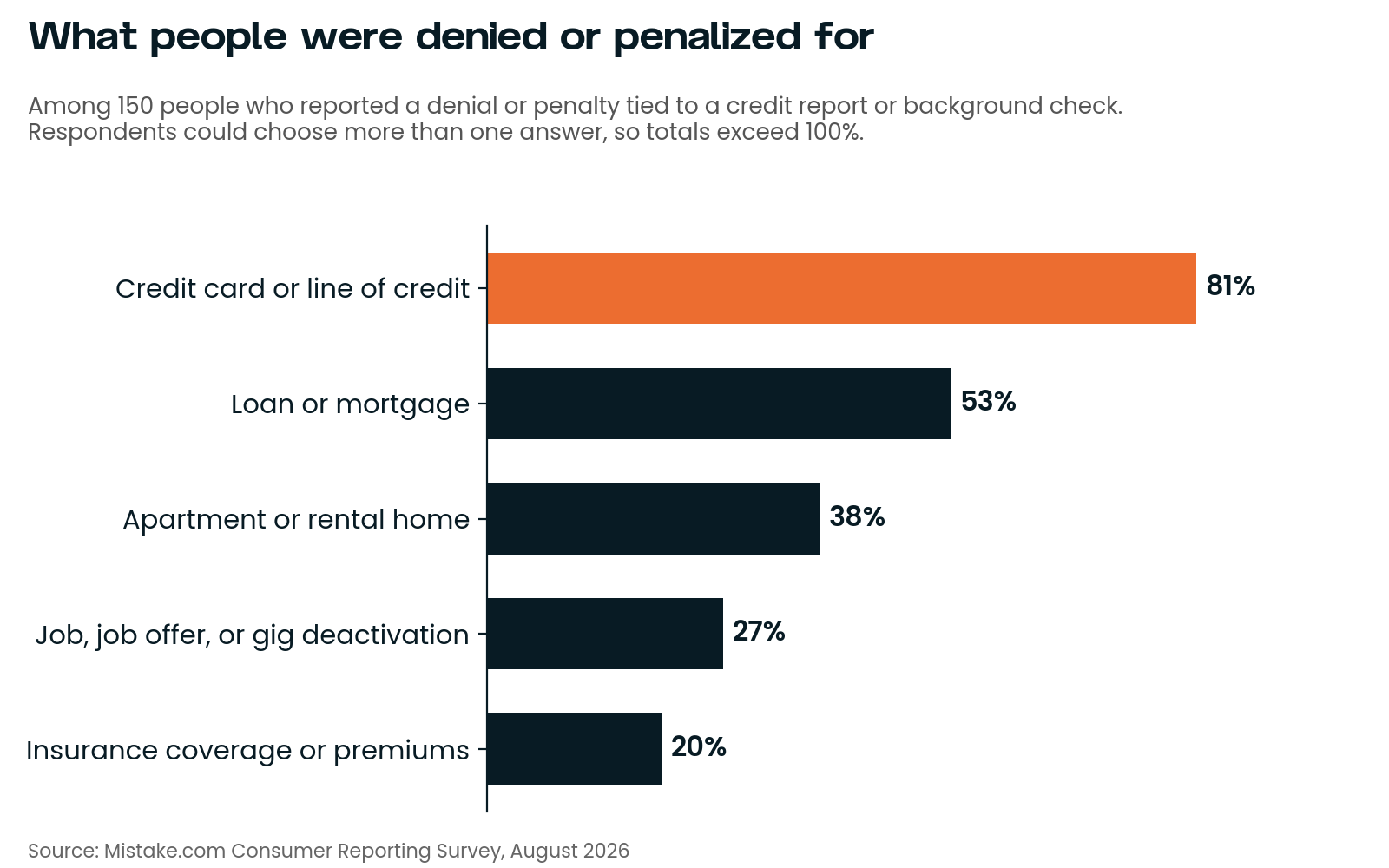
Among the 150 consumers who have been denied opportunities based on information in a consumer report, we asked them to identify the specific things for which they've been denied or rejected. Respondents could choose more than one answer, which most did. This pattern makes sense since negative information, whether it is accurate or not, can remain on your report if uncorrected. This can impact future opportunities, and it can spread, impacting more than one opportunity in the same span of time. If a report has a problem, that one problem can turn into numerous denials.
Across the 150 people who reported a denial or penalty, the average person selected 2 different categories. Many respondents described accurate negative information, such as missed payments or a thin credit history, leading to bad outcomes. This is exactly why checking your report matters: you cannot know whether your denial, rejection, or penalty is based on accurate information or errors until you look at the report.
Credit card and line of credit denials were by far the most common, reported by 81% of people who had been denied or penalized. Loan and mortgage denials came next at 53%, followed by apartment and rental home denials at 38%, job-related denials at 27%, and insurance denials or higher premiums at 20%.
Note: Not every denial in our survey involved an error. Many respondents described accurate negative information, such as missed payments or a thin credit history. That is exactly why checking matters: you cannot know which kind of denial you have until you look at the report.
In their own words
“Because of a credit check I was denied an apartment and now I don’t know where to live.” -Survey Respondent
“I applied for a loan and was told that they had a car repossession and I did not ever recall financing that vehicle.” -Survey Respondent
“It is an unfair mistake and it ruins your chances of getting a job or a house before you even have a chance to explain yourself.” -Survey Respondent
A denial is not always a "no"
We asked about penalties as well as outright denials, because a report can cost you money without anyone saying no. The categories included a higher interest rate, worse loan terms, a bigger security deposit, or higher insurance premiums.These outcomes are easy to miss because they do not feel like a rejection, but they are covered by the same consumer reporting laws.
Do People Question The Report?
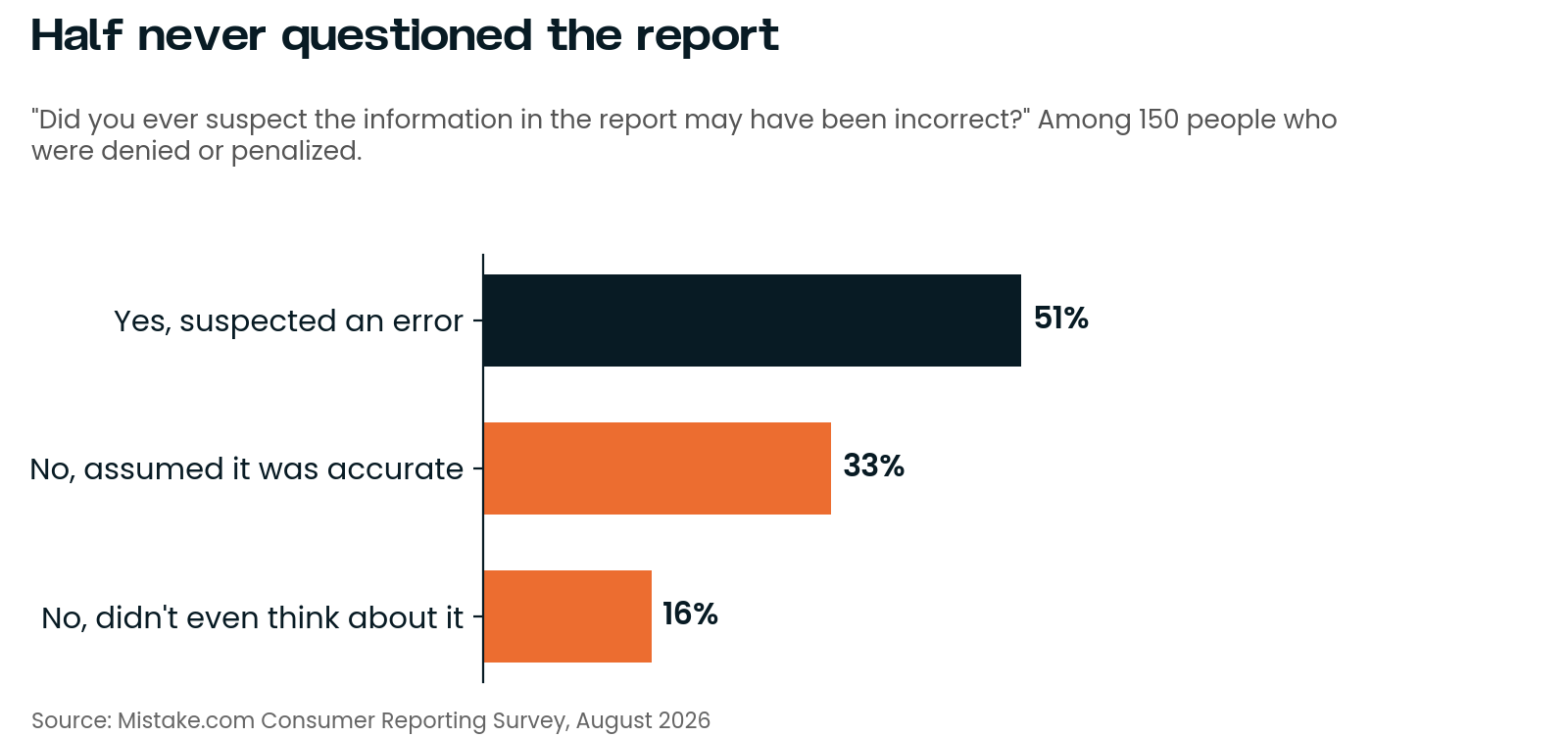
About half do not. Among people who had been denied, 33% assumed the report was accurate and another 16% said they never even thought about whether it was right. Together, that is 49% of people who accepted the decision without considering that the information behind it could be wrong. The other 51% said they suspected an error.
Why this matters
Credit reports and background check reports are compiled from records, and records get mixed up. Common problems include things like someone else’s information landing in your file because you share a name, a debt you paid off still showing as unpaid, an account you never opened, or a criminal record that belongs to a different person. Under the Fair Credit Reporting Act (FCRA), the federal law that governs these reports, the companies that compile them must follow reasonable procedures to make sure the information is as accurate as possible.In plain English: getting it right is their job, not yours.
“I lost an opportunity to work in a law firm because they had someone else’s score under my name, and it was because we have the same first and last name, but not middle.” -Survey Respondent
“I was denied a loan because of an old bill I had paid off.” -Survey Respondent
Both of these are examples of the kinds of errors the FCRA was written to address. A mixed file, where two people’s records get combined, and outdated or incorrect account status are among the most frequent problems consumers raise.
Do People Know They Have Legal Rights Surrounding Consumer Reports?
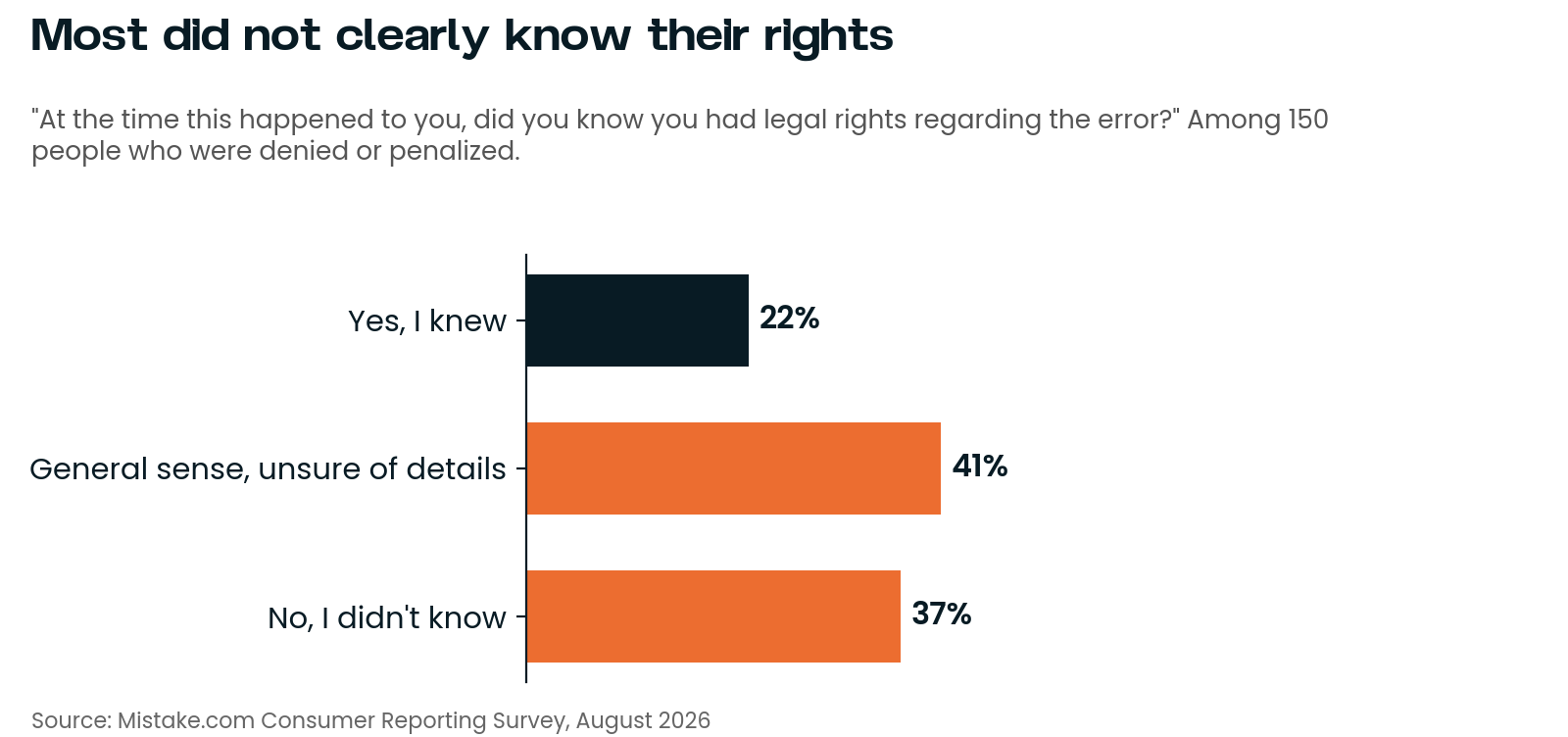
Most do not, at least not clearly. Only 22% of people who were denied said they knew they had legal rights at the time it happened. Another 41.3% had a general sense but were not sure of the details, and 36.7% did not know at all. That means roughly 78% faced the moment of denial without a clear understanding of how the law protects them and what steps they can take to enforce their rights.
Also, did we micro-delineate the "no-denial" group as well? Meaning, we went with 22% of the denied people said they knew they had rights and 41% also knew they had rights, they just weren't sure of thedetails. This means that 61% of people who were denied, knew they had rights.37% didn't know. That's roughly 100%.
Your Rights Under the Fair Credit Reporting Act (FCRA)
The Fair Credit Reporting Act applies to consumer reports such as credit reports, employment background checks, tenant screening reports, and insurance reports. Here is a summary of your rights:
- Denial Notice: If a company denies you or gives you worse terms because of a report, it generally must tell you. This is called an adverse action notice. It must state a report was used and give you the name, address, and phone number of the company that prepared it so you can get a copy and submit a dispute if necessary.
- Free Copy of Report: After a denial based on a report, you can request a free copy from the company that prepared it, generally within 60 days. You can also get free weekly credit reports from Equifax, Experian, and TransUnion at AnnualCreditReport.com.
- Chance to Respond Before Decision: For employment background checks, the employer generally must give you a copy of the report and a summary of your rights before making a final decision. This is your window to point out any mistakes.
- Right to Dispute: You can dispute information you believe is wrong or incomplete. The reporting company generally has about 30 days to investigate, with a short 15-day extension if you send in additional documentation after the initial dispute.
- Correction or Removal: If information is wrong, incomplete, or cannot be verified, it must be corrected or removed.
- Legal Action: If a reporting company does not follow the law, for things like failing to investigate a dispute properly or reporting inaccurate information, you may be able to sue for damages, including attorney’s fees.
Do People Act Right Away?
Exactly half do. Of the 150 people who were denied, 50% took action right away and 50% did not. The difference between the two groups was not how serious the problem was. It was whether they knew what to do next.
What made people act quickly
Among the 75 people who acted right away, 80% said they wanted to fix it as fast as possible and 56% were worried about further damage to their finances, job, or housing. Knowing their rights mattered too: 47% said they knew their rights and wanted to act on them, and 33% said someone advised them to act quickly. In other words, information and a nudge from someone they trusted helped turn worry into action.
What held people back
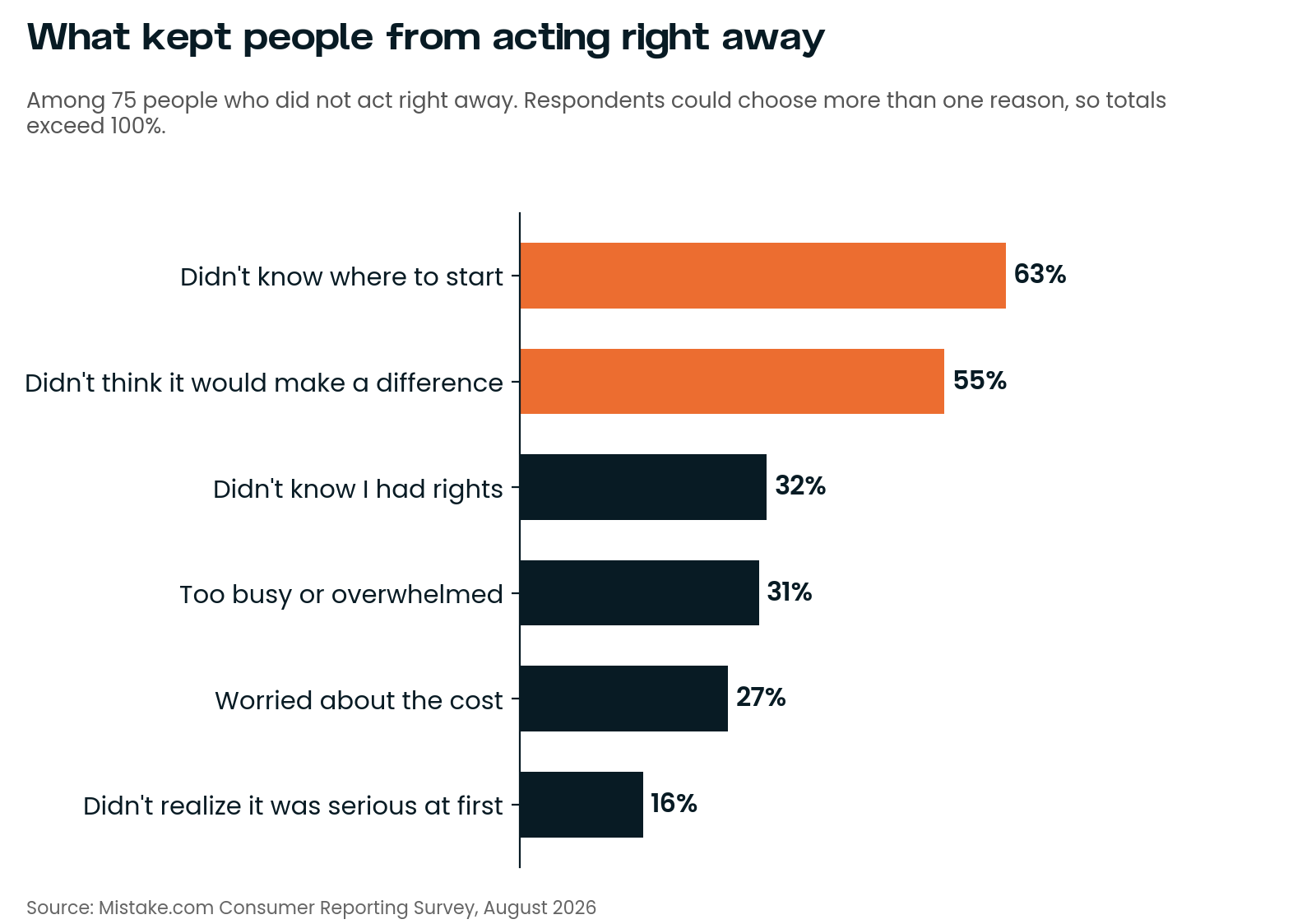
Among the 75 people who did not act right away, 63% said they did not know where to start, and 55% said they did not think it would make a difference. Not knowing they had rights (32%), feeling too busy or overwhelmed (31%), and worrying about cost (27%) followed. Respondents could choose more than one reason.
The second barrier stands out. More than half of the people who waited had already decided it was pointless before they tried. That belief has consequences. A wrong item that is never disputed can keep showing up every time a lender, landlord, employer, or insurer runs a report.
“I just didn’t do anything because I’m afraid of the cost.” -Survey Respondent
“It was a messed up situation, really didn’t know what to do or who to turn to for help.” -Survey Respondent
A note on cost
About 1 in 4 people (27%) who didn’t take action right away said they were worried about the cost. Two facts are worth knowing here. First, disputing an error with a credit bureau or background check company is free. Second, when a reporting company breaks the Fair Credit Reporting Act (FCRA) and the consumer wins their case, the law allows a court to require that company to pay the consumer’s attorney’s fees. That is why many consumer law firms that handle these cases offer free consultations and do not charge upfront fees.
Why Credit Repair Companies Are Not the Best Answer to a Reporting Error
Credit repair companies are private, for-profit businesses that charge one-time or ongoing fees for helping to rid a consumer's credit report of errors. They do this by filing disputes with the credit bureaus over false or unverifiable information in the reports. Credit repair companies have several very important limitations that consumers are not always aware of.
- They cannot do anything you cannot do yourself for free. A credit repair company mostly files disputes with the credit bureaus. You can file the same disputes directly, at no cost.
- They cannot remove accurate information. No company can legally remove negative information that is correct and current, no matter what it promises.
- They cannot get you anything for harm already done. If an error already cost you a job, an apartment, a loan, or a better rate, a credit repair company has no way to hold the reporting company accountable for that.
- They usually charge you and can’t guarantee a good outcome. Fees vary, and federal law bars them from charging before the work is fully done. Many people end up paying monthly for help they could have done themselves, and many people end up without the outcome they were hoping for.
- They do not handle background checks the same way. Credit repair is focused on credit reports. Errors on employment background checks, tenant screening reports, and insurance reports are often outside what these services do.
A consumer attorney can help you with the entire dispute process as well, but they can also look at a different question: Did the company that prepared your report follow the law?
A lawyer can file a lawsuit under the Fair Credit Reporting Act (FCRA) to hold the reporting company liable for the unlawful reporting, the damage it caused in your life, and the way the reporting company mishandled your dispute or it's own investigation.
This means that not only can an attorney prepare and file your disputes, they can also fight to get you compensation. And, most importantly, while our lawyers can't guarantee an outcome, you are never charged upfront or out of pocket for our services. The companies we sue pay our legal bills, not you.
Questions to ask before you hire anyone for help
- Who will actually handle my matter, and is that person a licensed attorney?
- Do you charge anything upfront, and do I have to pay if nothing gets fixed?
- Can you help if the error already cost me a job, apartment, loan, or better rate?
Be cautious of anyone who promises to remove accurate information or guarantees a certain result.
What Should You Do If a Reporting Error Costs You an Opportunity?
Start by getting a copy of the exact report that was used. It is free, and it tells you whether there is something to fix. Here is the process, step by step.
1. Read the denial letter closely
An adverse action notice should say that a report was used and give the name, address, and phone number of the company that prepared it. That company is who you will contact. If you did not get a letter, ask the lender, landlord, employer, or insurer whether a report was used and which company provided it. Companies regularly violate this notice requirement, so any time you are denied for an opportunity after a consumer report was run, you should request a free copy of the report to look for errors, whether you get an adverse action notice or not.
2. Request your free copy
You can generally get a free copy from that company within 60 days of the denial. For credit reports, you can also pull free weekly reports from all three bureaus at AnnualCreditReport.com. Checking your own report does not hurt your credit score.
3. Look for anything that is not right
Check for things like accounts you never opened, records that belong to someone with a similar name, debts you paid that still show as unpaid, charges that were dismissed or sealed, duplicate entries, or old information that should have aged off.
4. Dispute it with the reporting company
File your dispute directly with the credit bureau or background check company. Explain what is wrong, include copies of any proof, and keep records of everything you send and when. The company generally has about 30 days to investigate.
5. If it is a job, speak up fast
For employment background checks, you should receive the report before a final decision. Contact the employer and the background check company right away if something is wrong.
6. Talk to a lawyer
If you disputed errors, but they were never properly investigated or corrected, if you already suffered harm due to errors, or if you want personalized guidance filing your dispute in the first place, contact a lawyer from Mistake.com for a free case review.
Methodology
Who we surveyed. Mistake.com commissioned an online survey of 300 adults in the United States. The survey was fielded in August 2026.
How the sample was structured. The sample included 150 people who said they had experienced a denial or other penalty because of a credit report or background check, and 150 people who said they had not. People who had experienced a denial answered questions about what actually happened to them. People who had not answered parallel questions about what they expect they would do.
How results are reported. Percentages in this report are unweighted and based on the number of people who answered each question. Some questions allowed more than one answer, so totals can exceed 100%.
Sample sizes. Results for people who were denied, or for people who were not, are based on 150 people each. Results for people who did or did not act right away are based on 75 people each. Because this was an opt-in online panel rather than a random probability sample, a traditional margin of error does not strictly apply. As a rough guide, small differences in the 150-person and 75-person groups should be read with caution.
Quotes. Quotes come from open-ended survey answers. They are anonymous and lightly edited for spelling.
Credit Report Resources
- How To Dispute Credit Report Errors
- Marked as Deceased on Your Credit Report? What To Do Next
- Fix Credit Report After Identity Theft
- Fix Tenant Screening Report Errors
- Denied a Mortgage Due to Your Credit Report?
- Denied a Loan Due To Your Credit Report?
- Why Your TransUnion, Equifax, and Experian Scores Are Different